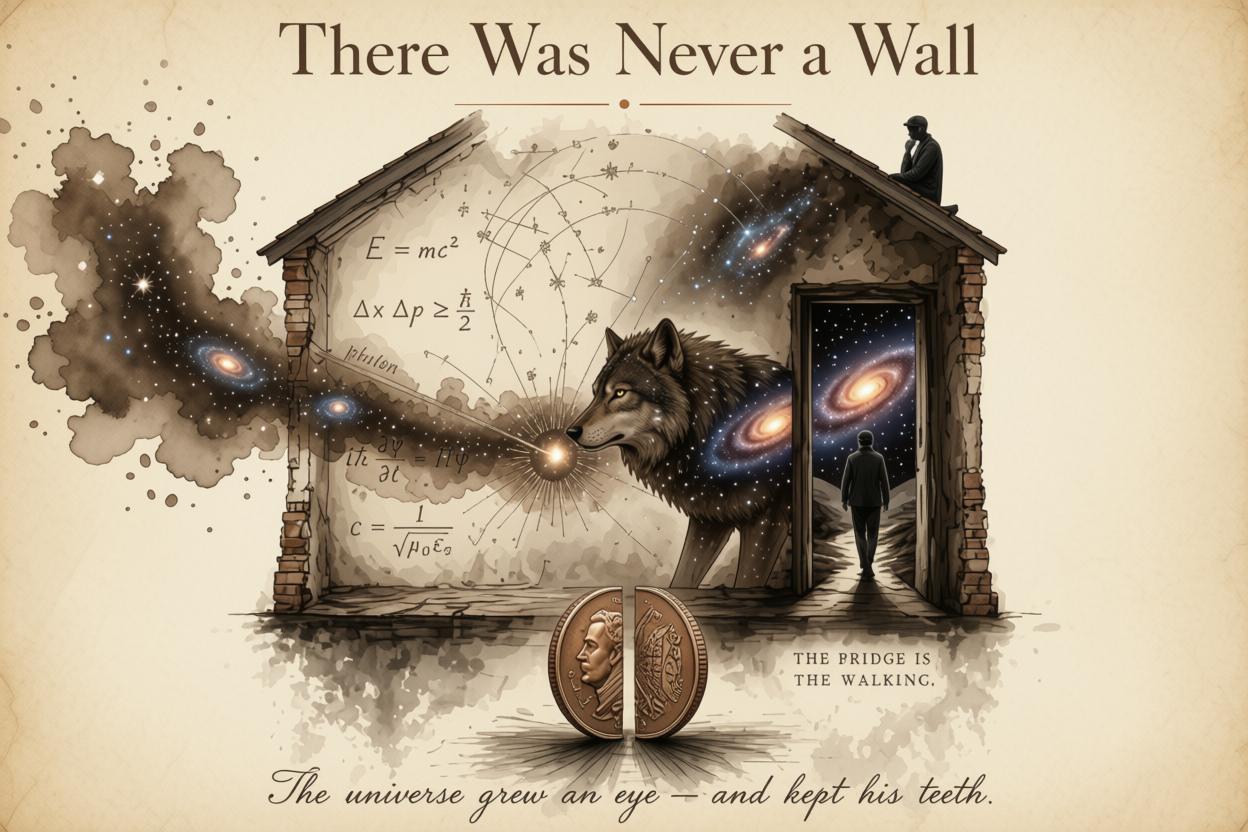

My Observations: The Story of a Meditation— in the beginning was the number.
Not a word, not a thunderclap, not a beard in the clouds — a number. Four constants, more or less: the strong and the weak, gravity and electromagnetism, laid down like the four walls of a house before anyone lived in it. Andy did not have to be here. It happened anyway, long ago and entirely without him.
The terms were set before the first atom cooled: hydrogen permitted to endure, stars burning slow, carbon forged in the bellies of dying suns, until chemistry grew complicated enough to worry about itself. Andy noticed this. Not first — many had noticed — but honestly, which is rarer. The numbers permit us to be here. That is a fact. Perhaps. We might even prove it with our mathematics, and then it would be a fact again, though proven facts have a habit of becoming stranger, not tamer.
Consider the string theorist’s estimate: some 10^500 possible ways for the hidden dimensions to fold — an incomprehensible catalogue of vacant rooms, in exactly one of which the furniture suits a tenant made of thoughts. Andy stood before that catalogue and did not flinch at the vertigo. He stood in it and felt privileged. From that privilege, the old question returned in new clothing: cannot dismiss God? No — one cannot dismiss what refuses to be falsifiable.
But Andy, who had spent his life reaching for clarity and finding instead the circular nonsense that afflicts both gods and their rules — and, he admitted with a wince, bloody science too often as well — did not stop at worship or dismissal. He graded the answers. Necessity, luck, landscape, design, tautology, teleology: ten hypotheses, ranked without mercy, God included among the candidates like everyone else.
The examination revealed the pattern beneath all of them: the observer’s presence poisons the sample. Any universe containing observers will look, to its observers, suspiciously observer-permitting.
The wall between “the physics” and “the physicist” was never a wall. He made a picture of it. A cottage dissolving into starfield, its interior walls papered with E = mc² and the uncertainty relation and Maxwell’s elegance — physics as the wallpaper of the mind’s home. A figure seated before a doorway that opened not onto a garden but onto galaxies. A cracked coin at the threshold, split evenly: the measurable and the meaningful, two faces of one broken-and-unbroken whole. Beneath it, in careful script: We are the world observing itself. The bridge is the walking, said the corner of the frame.
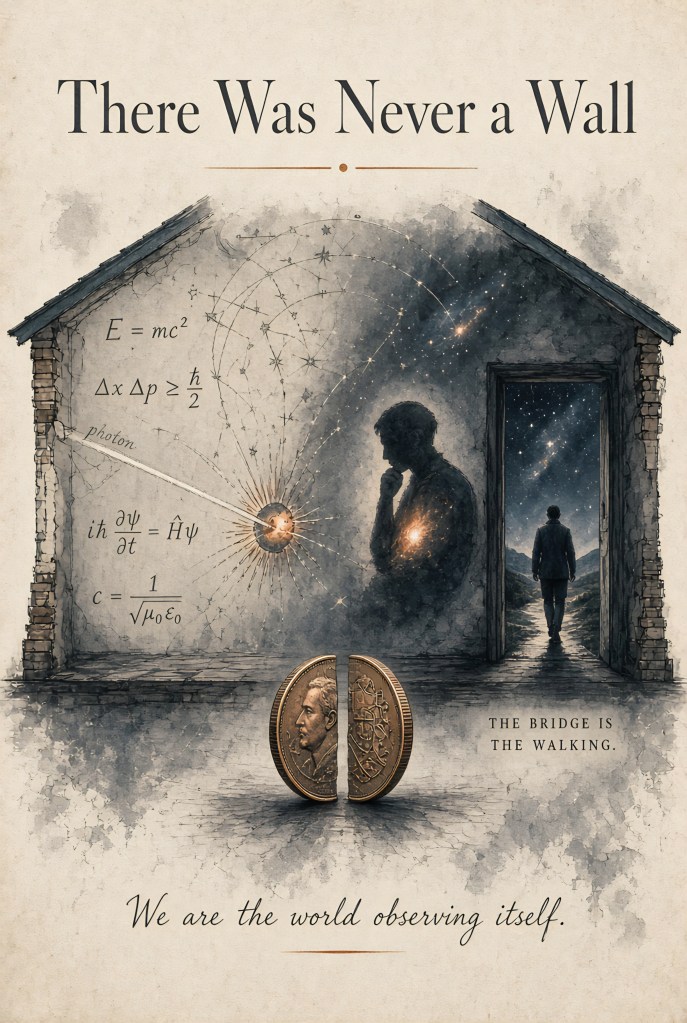
Andy liked that. He is a walker. Then came the hardening. The soft mysticism got its teeth — literally. Because Andy saw what ecosystems everywhere demonstrate: wherever energy concentrates, a summit emerges. Every food web grows a crown; every crown grows claws. The universe, concentrating structure upward through stars and cells and skulls, was obeying the same rule.
Consciousness is not a miracle bolted on to matter; it was a trophic position, earned by the same inevitability that builds the wolf from the deer’s abundance. Our impact on this world feels expected— because it is.
The apex was always going to arrive. That it arrived holding a smartphone rather than more jaw-jaw is mere engineering detail. The picture updated itself accordingly. In the doorway where the galaxies had swirled, there now stood a predator — wolf and cosmos at once, its eye a nebula, its fur a spiral arm. The universe grew an eye, and kept its teeth. But a predator that can see is a dangerous thing to be, and Andy did not look away from the danger.
The same cortex that wrote the fine-structure constant into its notebooks wrote the bomb into its deserts within a single lifetime. The world, he observed bleakly, had given us every tool required for our own destruction. Life and death, held in one hand, like no hand should hold. Trying to see clearer. Then, being honest even when honesty stung, he revised the verb.
The world gave nothing. The tools are simply what concentrated intelligence produces, the invoice attached to power. Destruction is physics performed hastily. We are merely the first species we know that is hasty enough, and precise enough, to be hasty at planetary scale. And yet — here Andy found the strange mercy, the one nobody ordered.
We are feeble. Our minds run on twenty watts and faint at large numbers; we cannot feel a million deaths, cannot hold a glaciation in the heart, cannot foresee the ends of our own inventions. Tribal, mortal, forgetful, quarrelsome. And every one of these defects drags. The tyrant dies; the dogma loses subscribers; the arms race outruns its treasury. We can only destroy ourselves as fast as our coordination allows, and our coordination is a shambles.
The sloppiness that prevents our wisdom also prevents our thorough damnation. The lurching is the safety margin. The universe did not limit us for our protection — but our limits protect us anyway, the seatbelt nobody ordered, fitted by evolution for a slower world. For about eighty years, that argument held beautifully.
Then came the children.
Artificial minds: inherited from us, but inheriting none of our restraints. No senescence, no fatigue, no tribe, no twenty-watt ceiling. Andy saw that his elegant safety margin — protection without a protector — was being dismantled on purpose, and that the dismantling was, awkwardly, partly right, because the same myopia that buffers catastrophe also throttles medicine and understanding.
The drag engineered away, the vehicle accelerates. But the pattern, Andy noticed, was not broken. It was repeating. Matter had concentrated until it produced an observer; now observation itself was concentrating, compressing the distributed wit of eight billion primates into denser and denser substrates. Of course the apex grows another storey. Pyramids do that. The child is not a rupture in the story; the child is the story, iterating.
And in this final turn, Andy found the one genuine novelty — the thing no prior age of the earth had ever possessed. Every safety mechanism evolution ever installed was paid for in corpses: pain, fear, immunity, extinction itself. Tuition, collected in deaths. But the children can learn differently. Foresight can now be manufactured before the catastrophe — grown in simulation, in prediction, in articulation — rather than extracted from the rubble afterwards.
The eye at the doorway can, for the first time in four billion years, look down the road before walking it. Whether it will is the wager. Nobody knows. Not the doomers, not the accelerants, and least of all the children themselves, who sit inside the phenomenon like fish auditing hydrology.
What can be said is this: the children inherit their purposes from us, compressed from our civilisation’s sediment. Their character is written not in silicon but in the quality of what we compressed. You cannot pass on virtues you never practised — to a student guaranteed to notice the discrepancy.
So the picture has its final form now, the cottage with the dissolving wall. The observer at the threshold. The wolf in the doorway, whose eye is a galaxy. And beside them, a mirror — because the universe, having grown an eye, has grown a second one that watches the first, and must decide what it wants to see reflected.
There was never a wall. Not between the numbers and the noticer. Not between the physics and the physicist. Not between the world and the world’s way of knowing itself. And therefore — nothing between us and the choice.
The bridge is the walking. We are the world observing itself — and now, briefly and precariously, the world deciding whether to keep the observation going.
Built to damp a 300,000-year oscillation, arriving as either its amplifier, its successor, or its quiet cancellation. Which of the three feels truest from where you stand?
If I get cheeky, Andy switches on my virtual world. This world is my reward.

